

Lou Koller, Founding Voice of Sick Of It All, Dies at 59
The New York hardcore icon, whose conviction, warmth and explosive stage presence helped carry Sick Of It All across four decades, has died following a long and publicly documented battle with esophageal cancer.
Sick Of It All announced on 24 July 2026 that vocalist and founding member Lou Koller had died at the age of 59. The band addressed its message to its worldwide hardcore family and described the loss of its brother, friend and frontman as overwhelming.
For generations of listeners, Koller was one of the unmistakable voices of New York hardcore: forceful without being theatrical, confrontational without losing the sense of solidarity at the music’s core. His death arrives in the year that would have marked Sick Of It All’s 40th anniversary.
Koller’s passing was announced after a two-year public fight with esophageal adenocarcinoma. The band’s announcement did not publish a separate medical cause-of-death statement. Out of respect for Lou Koller and his family, Altars Of Metal will not speculate beyond the information made public by the band and the Lou Koller Fund.
“We have lost a beloved friend and an iconic frontman.”
Sick Of It All, official statement — 24 July 2026
The statement remembered Koller not only for his commitment to the band, but for his humour, sarcasm and ability to lift the atmosphere wherever Sick Of It All played. It also thanked the fans, musicians and friends whose donations and messages made him feel supported throughout his illness.
A public fight met by a worldwide community
In June 2024, Koller revealed that doctors had found a cancerous tumour in his esophagus extending toward his stomach. Sick Of It All immediately cancelled its European tour so that he could begin treatment. The Sweet Relief Musicians Fund later identified the diagnosis as adenocarcinoma and reported that he underwent surgery and chemotherapy.
Koller publicly announces an esophageal tumour; Sick Of It All cancels touring so he can focus on treatment.
The “I’m In The Fight With Lou” benefit takes place at Irving Plaza in New York with Vision Of Disorder, Life Of Agony, Municipal Waste, Killing Time and Crown Of Thornz.
After surgery and chemotherapy, Koller tells supporters that he has been declared cancer-free.
Further scans reveal that the cancer has returned after a difficult recovery, and treatment resumes.
Sick Of It All announces Koller’s death at 59 and thanks the global hardcore community for standing beside him.
The response to his illness demonstrated how far his influence extended. The Irving Plaza benefit brought together multiple generations of New York heavy music, while the associated crowdfunding campaign had raised more than $380,000 by the time of his death. AFI, Rancid and Dropkick Murphys were among the artists reported to have made major contributions, alongside support from across punk and hardcore.
Who was Lou Koller?
Raised in Queens, New York, Lou Koller grew up in a close family alongside his brothers, including future Sick Of It All guitarist Pete Koller. In a wide-ranging 2024 conversation with Norman Brannon, Lou rejected the mythology that every hardcore musician needed a fabricated street-war biography. He credited his upbringing with teaching him not to judge people by appearance, but by their actions.
Before music became a full-time life, he held ordinary working jobs, including work in a carpet factory’s art department and a mailroom, while also spending time around theatre and fashion. He left the factory in 1989 when Sick Of It All had the opportunity to tour with Bad Brains and Leeway—an early turning point in a career that would eventually take the band around the world many times over.
That working-class background never disappeared from his public character. Koller spoke plainly about the economic reality of maintaining a hardcore band, the strain of constant touring and the importance of treating younger musicians with respect. Away from the stage, he described a quieter family life built around reading, films and time with his daughter.

His songs could be furious, but Koller was explicit about what that anger meant. He said Sick Of It All’s music was never intended to turn people in the room against one another; it was an outlet for collective frustration and a reminder that the people in the scene were facing the outside world together. That distinction—anger joined to unity—remains central to understanding his work.
Urgency without distance
Koller performed with exceptional physical energy, but his connection with audiences came just as much from humour, eye contact and the feeling that no barrier existed between band and crowd.
Respect as a principle
Across interviews, he repeatedly returned to open-mindedness, learning from younger generations and treating people decently—values that gave substance to Sick Of It All’s message of solidarity.
In 2020, Lou and Pete Koller told their story in The Blood and the Sweat: The Story of Sick of It All’s Koller Brothers, written with Howie Abrams. The 552-page autobiography documented the family, friendships, sacrifices and scene history behind one of hardcore’s most durable bands.
Sick Of It All: four decades of New York hardcore
Founded in Queens in 1986 by Lou and Pete Koller, Sick Of It All became one of the defining institutions of New York hardcore. The long-running classic lineup—Lou on vocals, Pete on guitar, Craig Setari on bass and Armand Majidi on drums—was notable not only for longevity, but for preserving a recognisable identity through changing eras of punk, metal and alternative music.
The early self-titled release for Revelation Records introduced a direct, economical sound, while Blood, Sweat and No Tears and Just Look Around expanded the band’s reach. The 1994 album Scratch the Surface became an international breakthrough, driven by songs such as “Step Down” and its title track. The major-label years continued with Built to Last, but the band resisted changing its music simply to chase the market.
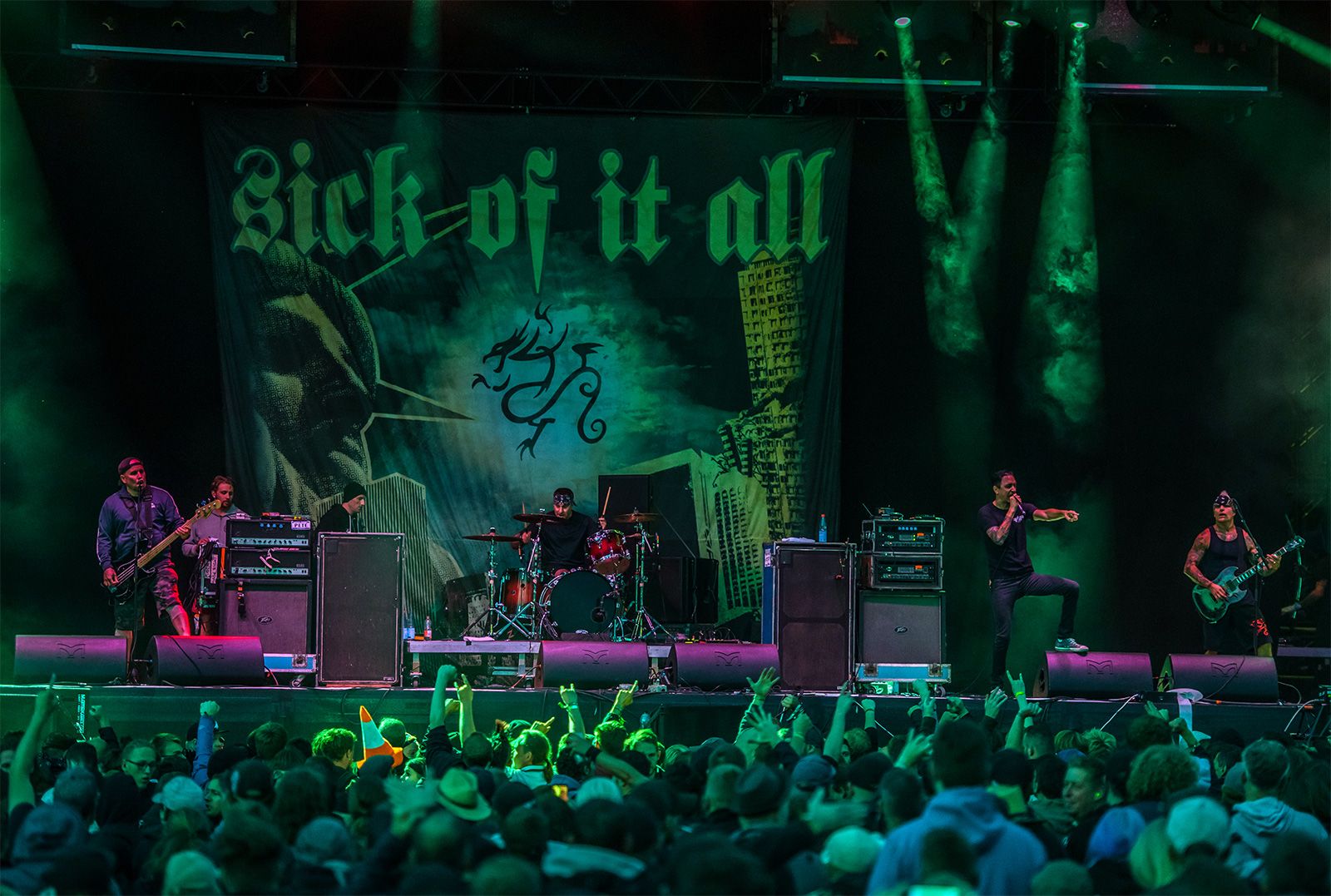
Later records showed that durability did not have to mean repetition. Koller identified 2006’s Death to Tyrants as a particularly complete expression of Sick Of It All—a record that renewed the band’s momentum while retaining its core voice. Their most recent full-length, Wake the Sleeping Dragon!, arrived in November 2018 through Century Media.
The official band biography describes a catalogue of eleven full-length albums and a career that carried Sick Of It All around the world repeatedly. Their influence crossed scene boundaries: they toured with metal bands, supported and encouraged younger hardcore acts, and became a reference point for artists whose own audiences sometimes arrived decades after the band’s 1986 formation.
The catalogue also includes the foundational 1987 self-titled release, the 2011 re-recording project Nonstop, live recordings, compilations and the 2016 EP When the Smoke Clears. More important than any count, however, is the continuity: each era carried the same combination of rhythmic force, street-level realism, frustration and fellowship.
The mark Lou Koller leaves behind
Lou Koller’s importance cannot be reduced to volume, longevity or even influence. His real achievement was making conviction feel communal. Onstage, he could turn a room into controlled chaos; between songs, a grin or a dry remark reminded everyone that hardcore did not need to become self-important in order to matter.
His voice remains embedded in songs that have travelled through basements, clubs, festivals, skate videos, rehearsal rooms and headphones for nearly forty years. For musicians, Sick Of It All offered a model of how to grow older without abandoning the values that made the music necessary. For fans, Koller was the familiar figure at the centre of that continuity.
Altars Of Metal extends its deepest condolences to Lou Koller’s family, to Pete Koller, Craig Setari and Armand Majidi, to his friends, and to the worldwide Sick Of It All and hardcore community.
His battle has ended. The positive mark he left—through the records, the concerts and the people he treated with warmth—will remain.
Rest in power, Lou Koller.
Sources and further reading
- Sick Of It All — official announcement, 24 July 2026
- Metal Injection — “Lou Koller, Vocalist of Sick Of It All Dead at 59”
- Blabbermouth — death announcement, cancer timeline and benefit information
- Sweet Relief Musicians Fund — Lou Koller Fund and treatment updates
- Sick Of It All — official biography
- Sick Of It All — official discography
- Anti-Matter — Norman Brannon’s 2024 interview with Lou Koller
- Kerrang! — career-spanning Lou Koller interview
- The Blood and the Sweat: The Story of Sick of It All’s Koller Brothers
This article was compiled from the official band announcement, official band and fundraising pages, primary interviews and established music publications. It will be updated should the Koller family or Sick Of It All publish further confirmed information.
About the Author: SLATAN

Keep Reading
Related Coverage



Join the Altars
Metal news, exclusive interviews, live reports and new episodes
from Το Καφενείο των Μεταλλάδων — without the noise.